Purnesh Gali

Things I’m noticing, thinking, and building, mostly about AI.

Computers Without Codex/ Claude Feel Primitive

I am seeing a dramatic shift internally in how we use computers over the last couple of months. Not just how we develop software, but how we use computers in general.

The starting point for everything I do these days is Codex/Claude. Building product, managing AWS, talking to customers, managing sales, and everything in between.

Whatever I need sits behind these now. SharePoint, a database for user analytics, Sentry/CloudWatch for a product issue, the CRM for pipeline reviews. I almost never log into any of these directly anymore.

We are simulating end-to-end user journeys and complex test scenarios entirely through Codex computer use. Still feels unreal.

Heck, I don’t even open Excel/Word/PPT as the first step when I create proposals.

They have truly become platforms. Just like any platform, there’s so much you can do and build on top of them, and I keep finding new workflows to wire up every week.

It might take time for this behavior to spread across enterprises, but man, it already feels primitive to use a computer without Codex/Claude.

Originally posted on LinkedIn.

AI Coding Agents Are Becoming Headcount-Level Spend

I exhaust my $200/month Codex plan in days now, and I can clearly see how companies are going to spend $200 per employee per day on AI soon. The economic impact of this on any organization is going to be wild.

Some already do. Some realize it is only a matter of time before they have to. The rest will realize soon.

Everything the labs are doing with Codex and Claude Code is to make it super easy for developers to exhaust their limits super fast. Running multiple agents in parallel, each having subagents, /goal, fast mode, and many more that they keep releasing every week.

Our $20/month to $200/month transition took months. But $200/month to multiple $200s/month was faster. And for some, $200/week was even faster. I can clearly see entire engineering teams spending $200/day/dev.

If AI coding agents add $40-50k/year per developer, that is no longer a tool budget. That is headcount-level spend. This becomes core infra for organizations.

There are so many ways this could branch off.

Maybe $200/day is not required for all companies. Maybe everyone does not need frontier capabilities. Maybe open source will make this $200/day into $20/day. If we compare the current frontier pricing to iPhone, maybe the industry will find an Android.

Or maybe, just like bandwidth used to be this ridiculously expensive thing and eventually became a commodity, coding will become like that too.

I doubt the current path of tokenmaxxing is a sustainable strategy. So many interesting things to build around this!

Originally posted on LinkedIn.

GPT-5.5

I like Codex and the desktop App a lot, but there is something off with 5.5. It doesn’t seem to put in the effort to do what I ask for (lazy?), it talks to me like an alien when I refer to something from just two messages ago, and it is just not good with long context.

Maybe I am used to the incredible long context conversations with 5.4, maybe the lesser context is really hurting, maybe it is not for every problem, maybe I need to update my workflow, but I am yet to experience what the hype about 5.5 is.

Either way, 5.5 is not just an incremental model. There is a lot going on with this model, and you cannot just switch from 5.4 to 5.5 and assume everything will be okay.

Originally posted on LinkedIn.

Speech-to-Text Made Me Realize I Think Better When I Write

I came to two unexpected conclusions after using speech to text AI for everything from coding to emails over the last few months:

  1. Our physical spaces are not built for people constantly speaking. They are built for silence. Open offices work well because we assume people won’t speak most of the time. For speech to text to really become mainstream, it needs to become 10x better than writing, so much better that we are willing to change our physical spaces to benefit from it.

Does that mean fewer open offices? I don’t know, but it’s very hard to use STT tools 90% of the time in current office designs. I am not talking about speaking to your phone or computer occasionally to ask for a reminder, but using STT as the main form of input.

  1. I think well when I write, not when I speak. This was unexpected and surprising to me. After many years of writing everything from code to presentations to emails, my thoughts flow well when I write. But I find myself stuck when I try to speak the same thoughts. Writing and thinking is very natural and free flowing for me. It’s effortless. I just write as I think, and sure sometimes my thoughts are faster than I can type, but the thoughts are flowing only because I am writing.

When I start speaking, I usually get stuck. Is it just me? Will the next generation who enters the workforce now only speak to their computers, so their thoughts will naturally flow better when they speak? I’m not sure. But for me, as of today, writing is more creative and free-flowing.

STT AI has become incredibly powerful and accurate over the last few months. So if you haven’t tried them in a while, you’d be surprised how far the tech has come.

Would love to know your thoughts if you’ve been using speech to text.

Originally posted on LinkedIn.

Search Intent and AI Search

Three random thoughts:

  1. Search intent is important for monetization. I usually don’t search for things to buy on Instagram. It is for people or places, and they monetize with ads. But on Amazon, I am searching with intent to buy 100% of the time.

Amazon must be converting those 3.5B into revenue at magnitudes far higher than Instagram with 6.5B. This might be changing with TikTok commerce; I have no idea how that works.

  1. The size of the search pie has increased tremendously over the last few years, so while Google might be losing market share in that sense, their search revenue is better than ever. A bigger market helps everyone.

  2. Your poll with ChatGPT at 60% is an indication of where we are going. Folks in our tech bubble are adapting it first, and then it will slowly affect everyone. ChatGPT’s searches are less today, but so was the smartphone market in 2007.

Originally posted on LinkedIn.

Qapita and the Work Behind Market Expansion

I was having coffee with Lakshman earlier today, Qapita co-founder, the same day the news about their new round and strategic partnership became public. Serendipity?

Since I met him about two years ago, he was always talking about their strategies for the US market. Today’s announcement might feel like an overnight success to outsiders, but only he and his team know how much thought and effort went into making this happen.

Congrats to the entire Qapita team.

Originally posted on LinkedIn.

Trying Sora Cameos

Got to try Sora, and using Cameos genuinely put a smile on my face.

I have a few invite codes, drop a note if you wanna try. Available in the US only.

Originally posted on LinkedIn.

Standardizing AI Tools Doesn't Make Sense Now

Codex is damn good. So good that I canceled Claude Code and switched. Funny thing is, I remember doing something similar just a few months ago by switching to Claude Code from Cursor. And GitHub Copilot before that.

Each cycle of using a tool is getting shorter and shorter. We might have used Copilot for many months, Cursor for a few months, and Claude Code for a couple of months. Not sure how long Codex is going to last.

That brings me to everyone’s favourite question: do foundation models have a moat, or will they just become infrastructure given enough time?

As a user, I don’t care. It doesn’t matter. I don’t have affinity or loyalty toward any of them. Sure, I enjoyed Claude Code until it became annoying. But whatever lets me ship that next feature faster is the only loyalty.

If the rate of change is so intense, how do you standardize any tool at a company? We cannot and should not.

We decided to give everyone at Actalyst a free hand to subscribe to any AI tools, up to USD 200 per month. Users should choose what’s best for their workflow.

Originally posted on LinkedIn.

Gemini 2.5 Pro Season

If your coding workflow still revolves around Claude 3.7, you’re so April 2025. It’s May already. It’s Gemini 2.5 Pro 05-2025 season. Time to evolve.

If you smirked, welcome to the club. What’s your coding workflow these days?

Originally posted on LinkedIn.

Better Products Are Hard to Explain Unless Experienced

Having only used MS Teams throughout my professional life, I never truly understood the beauty of Slack until I started using Cursor.

I always wondered what the big deal about Slack was. You can chat and do so many other things in Teams that aren’t even possible in Slack.

I hypothesized from a theoretical perspective, made a checkbox comparison, and concluded that Teams ticked all the boxes Slack did, so there was no need to try it.

Every time I wanted to try, my analytical mindset dominated and said it was just hype, that the actual functionality was the same.

If I were still at an enterprise, I would today feel the same about Cursor. What’s the big deal with Cursor? GitHub Copilot has everything. It checks all the boxes.

If you use both, you’ll immediately prefer Cursor over Copilot. Maybe Copilot is a tad slower. Maybe it’s a bunch of small things that don’t even sound like a big deal until they add up and make the overall experience feel dramatically different.

I’ve felt this “beyond checkboxes” so many times over the last couple of years. Building a startup is helping me see why these products win, even when big companies already offer something similar.

Now I know: it’s never about features, and it’s impossible to explain in words. Don’t bother convincing someone who’s never used Slack why it’s better; you’d always lose the argument.

Most enterprise software experiences suck. We’re trying to change that, in whatever way we can, at Actalyst.

This isn’t a knock on GitHub Copilot. It’s still early. For all we know, Microsoft might nail the execution and make it awesome. They might have the deep pockets to discount it heavily or bundle it smartly, and still win.

Originally posted on LinkedIn.

NotebookLM Shows How Fast AI Becomes a Feature

It’s wild how quickly groundbreaking AI products become standardized features.

NotebookLM blew minds. Now, Microsoft has made it just another feature in Copilot. I haven’t tried it, so no idea how good or bad it is.

We marveled at foundational LLMs not too long ago, and now the same thing is happening at the application layer.

Whatever feels magical today can become a default feature tomorrow. The compounding is brutal and exciting at the same time.

Originally posted on LinkedIn.

Vibe Coding

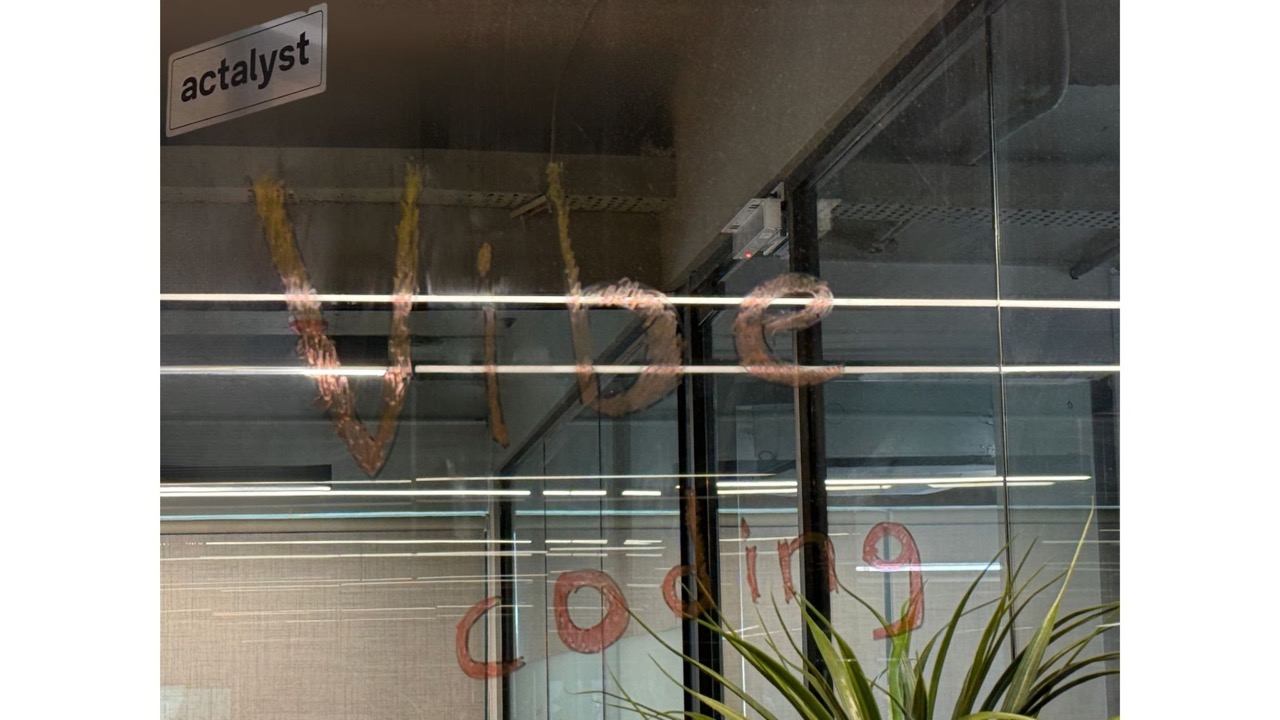
This had to go up on our walls. Shipping at the speed of vibes.

#vibecoding #aicoding #actalyst

Actalyst office glass wall with the words "vibe coding" written across it.

Originally posted on LinkedIn.

Actalyst at NVIDIA AI Summit India

Excited to share that we have been invited to be a part of the Inception Startup Pavilion at NVIDIA’s AI Summit in Mumbai.

Looking forward to connecting with fellow AI enthusiasts and business leaders. See you there.

Originally posted on LinkedIn.

Actalyst turns 1

As Actalyst turns one, it’s the unusual little things that brought me joy.

I haven’t received even one last-minute “I am taking the day off” email. You can imagine how frustrating such announcements can sometimes be when you had planned a few things for the day.

In some corporate structures, employees feel forced to utilize all their allotted sick days and vacations, even if they are not truly needed.

There is nothing wrong from the employee’s perspective. I did this too. But the structure often incentivizes employees to surprise with last-minute “I’m taking today off” calls that disrupt team rhythm and morale.

I’m incredibly grateful to be a part of this amazing team with Varma and Aravind, where everyone’s super into what we do.

Nobody’s counting sick days or eyeing the clock for vacation time. It’s not about using up days off, but about being part of something bigger and taking the time off when needed.

#Actalyst #1YearReflection #2023

Originally posted on LinkedIn.

Opportunities at the Edges of AI

It is impossible to ignore how generative AI is disrupting creative fields these days. Here is my personal experience using it for interior design, which also led me to realize how lucrative startups could be built on top of ChatGPT.

I gave ChatGPT the floor plan of my cousin’s flat and asked for design ideas inspired by traditional Indian aesthetics.

What’s incredible is how easily I could translate my intent, convert that into images, and iterate until I got something impressive in just a few minutes. A job long considered creative and time-consuming has come down to a few good prompts.

However, ChatGPT cannot create the technical drawings or specifications needed to actually execute the designs. So there is still a human role in the loop.

Build software that takes ChatGPT’s interior design images and automatically converts them into technical drawings based on a provided floor plan.

More broadly, identifying and filling gaps around GPT’s inputs or outputs could lead to promising startups.

Rather than building obvious features on top of GPT that OpenAI would likely add themselves, identifying complementary opportunities that complete gaps in ChatGPT’s capabilities could be lucrative.

As the GPT Store rolls out, gaps around its offerings can turn into startups. Where the tech falls short in completing end-to-end creative processes, entrepreneurs can fill the void.

#GenerativeAI #AIInTheLoop #Startups #Actalyst #GPTStore

Originally posted on LinkedIn.

OpenAI language model has shattered my fundamental belief system

I have been following OpenAI for a long time, so when they announced a public beta of their latest language model, GPT-3, I was one of the first to request and get access to the API.

I have always believed that programming, writing software, or developing ML models are skills that take years and years of practice and cannot be easily automated. But boy, was I wrong.

GPT-3 has shattered some of my most fundamental beliefs around machine learning and software in general: absolutely mind-blowing stuff.

I haven’t experienced anything like this before. In a matter of a couple of hours, I was able to read through the API documentation and build a chatbot that may be better than most enterprises will ever have, write a poem, summarize a consumer terms and conditions statement into simple English that anyone can understand, have a lot of stupid fun, and still have time left to write this post.

Still figuring out the art of priming, so I don’t have good examples to post yet. I will do a detailed post soon. The API in general has a lot of quirks, especially with India-specific context, which may take a couple of iterations to be ready for prime time. But let me explain what may happen when this takes off.

AWS is to infrastructure, GPT-3 is to ML.

Let’s understand with a narrow example first.

Business users used to rely heavily on specialist data analysts to derive even basic metrics and trends from their data until Tableau came along with a pioneering product that reduced friction between users and data.

A slightly broader example is how AWS removed friction between infrastructure and developers and dramatically reduced the timeline to start something new from months to minutes. It took months for me to set up and run my first analytics pipeline on Hadoop.

GPT-3 is aiming to abstract away the complexity of machine learning, which is the training of models, through simple English-language instructions.

This would have far-reaching impact beyond any of the above examples. There are already examples of generating code for a web app through this API.

We are going to compete with AI for jobs.

I am not able to completely comprehend the impact of such models on the world, but I have changed my beliefs and accept that we are going to compete with AI for many current jobs.

Just to be clear, I am not talking about blue-collar jobs or jobs that can be easily automated, but jobs like data scientists and software engineers as well. It may take a decade, but I don’t question the possibility anymore.

I can’t wait to explore further and share my findings. Happy to try out any specific use case or answer questions.

#OpenAI #GPT3 #AI

Originally posted on LinkedIn Article.